

The hidden psychology behind cognitive debt and AI dependence.
Over the last couple of years, I’ve spent an awful lot of time working with AI.
My work revolves around building AI agents, designing AI workflows, prompt engineering, and creating systems that automate intensive work. Working closely with Claude, ChatGPT, Gemini, and other AI tools gives me a front-row seat to observing how quickly the technology is changing—not just the way we work, but the way we think.
However, somewhere along the way, I noticed something strange.
Although AI models and responses keep getting better, my willingness to read long AI-generated responses has taken a serious hit.1
If an answer looks too long, I skim it. If it still looks too dense, I ask the agent to summarize its own response. Instead of spending five minutes understanding an idea, I would usually spend 30 seconds looking for the conclusion.
And I am not alone.
Almost everyone I know who works with AI has developed the same habit. We don’t read AI responses anymore—we scan them.
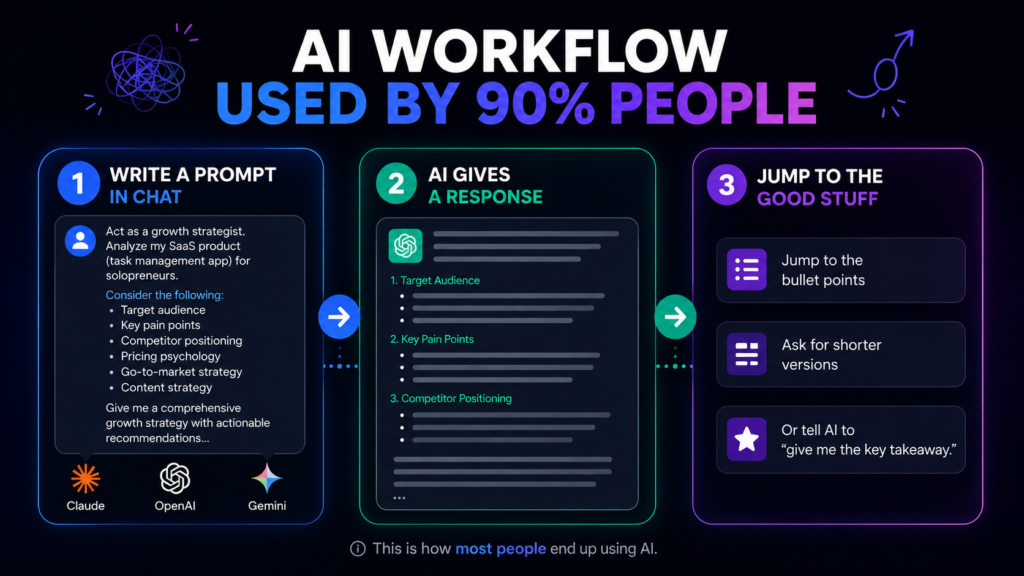
It feels harmless. In fact, it feels efficient. You almost get to enjoy feeling like Marvel’s Iron Man giving operating commands to Jarvis.
AI was essentially developed to make work easy, fast, and more productive. And to be fair, it does.
But I think something very dangerous is happening at the same time.
The moments when we as humans have to genuinely think about a task or a goal by ourselves are further apart than ever before in human history.
More often than not, thinking has become optional. It can be outsourced to an AI agent sitting in your pocket, always available, always ready with a response.
Not long ago, technology mostly helped us reduce physical effort or save time. A calculator saved us from manual and grim calculations. GPS made memorizing routes redundant. However, for the first time in human history, we can not only outsource manual work—we can outsource thinking.
At first glance, that sounds like progress.
Why would anyone spend twenty minutes wrestling with a problem when AI can give you a reasonable answer in seconds?
With the current trajectory – slowly, almost invisibly, yet inevitably – our relationship with thinking will begin to change. Researchers have already begun to pay attention to this phenomenon.2
One of the ideas emerging from that conversation is cognitive debt—the hidden cost that accrues every time we outsource thinking effort without remaining mentally engaged in the process.
The problem is that cognitive debt doesn’t appear in a single interaction. It accumulates after hundreds—sometimes thousands—of small decisions where we quietly stop exercising the very ability that helps us reason, question, struggle, and arrive at our own conclusions.
A Weekly Newsletter for Clarity & Updates.
Psychology, AI leverage, and the systems behind smart decisions — delivered directly to your inbox once a week.
No spam. Unsubscribe any time.
The Real Cost of AI Isn’t Compute Credits. It’s Everything You Skip to Get There.
One thing I’ve noticed after working with AI every day is that I no longer start with a blank page. Whether I’m writing an article, preparing a presentation, replying to an email, or thinking through a business problem, my first instinct isn’t to spend a few minutes wrestling with the problem myself. It’s to open Claude or ChatGPT and ask for a starting point.
At first, that felt like a productivity hack. Why spend twenty minutes structuring your thoughts when an AI agent can organize them before you’ve even had your first cup of coffee?
It’s difficult to argue against that logic because, in most cases, the outcome really is better and significantly faster.
The problem is that we often mistake the final output for the entire process.
When we think through a difficult problem ourselves, our brain is doing far more than searching for an answer. It’s comparing ideas, rejecting weak arguments, noticing patterns, questioning assumptions, changing direction halfway through, and slowly building confidence in a conclusion. None of that invisible work appears in the final answer, which makes it incredibly easy to believe that the answer was the only thing that mattered.
That’s the quiet trade-off AI introduces in the workflow.
The technology doesn’t just reduce the time it takes to complete a task; it also reduces the number of moments where we have to sit with uncertainty long enough for our own judgment to develop.
The more frequently AI becomes the starting point of our thinking, the less often we exercise the mental processes that made the answer valuable in the first place.
This is where an important distinction begins to emerge.
Humans have always relied on tools to reduce cognitive load. We write things down instead of memorizing them. We use calendars instead of remembering every meeting, calculators instead of performing long calculations, and GPS instead of carrying entire cities in our heads.
Psychologists describe this as cognitive offloading, and for the most part, it’s an incredibly healthy adaptation. It frees up mental bandwidth for problems that deserve our attention.
AI changes that equation in a subtle but important way.
There’s a world of difference between asking technology to remember something for you and asking it to think through something for you. One extends your memory. The other begins to substitute your judgment. Individually, those decisions feel harmless and often completely rational. Repeated hundreds of times, they quietly reshape the role your own mind plays in solving problems.
And that’s why cognitive debt is so difficult to recognize.
It doesn’t accumulate because of one important decision. It builds every time convenience quietly replaces contemplation, until one day you realize that your first instinct is no longer to think through a problem—it’s to delegate the thinking before you’ve even given yourself the chance.
How Scientists Are Beginning to Notice Cognitive Debt

For a long time, the whole debate around AI and thinking was merely speculation. Skeptics would argue ChatGPT makes us lazy, while the fan clubs proposed it made us more productive. The radicals inevitably declared that AI is going to make us all unemployed by Tuesday.
The problem was that we didn’t have much evidence to settle the argument. However, that changed recently.
In 2025, researchers at MIT Media Lab divided a few people into three groups and asked them to write essays: one group used an LLM, another used a search engine, and the third had nothing except their own brains. The researchers used EEG to observe the brain activity while they worked.3
The results were interesting. The brain-only group showed the strongest and most distributed neural connectivity. The search group showed moderate engagement, while the LLM group showed the weakest connectivity. The LLM users also reported less ownership of their essays and had more difficulty accurately recalling parts of what they had written themselves.
Now, before you start cancelling your AI subscriptions, there is an important caveat. This was a relatively small study, with 54 participants across the first three sessions and 18 completing a fourth session, and the paper remains a preprint. It doesn’t prove that using Artificial Intelligence is slowly turning your brain into mashed potatoes.
However, what it does show is worth paying attention to: when the AI did more of the cognitive work, the brain showed less engagement with the task.
Then there’s another study that makes the picture even more interesting.
In 2025, researchers from the University of Pennsylvania and other institutions conducted a large-scale randomized controlled trial with nearly 1,000 high-school students learning mathematics.4 Students using a standard GPT-4 interface performed substantially better while they had access to it.
Then the researchers took the AI away.
On the unassisted exam, students who had used the standard GPT-4 interface performed 17% worse than students who had never had access to it. Researchers noticed that students were often using the AI as a “crutch”, asking for solutions and copying them rather than working through the problems themselves. A separate version of the AI designed with learning safeguards largely avoided this negative effect.
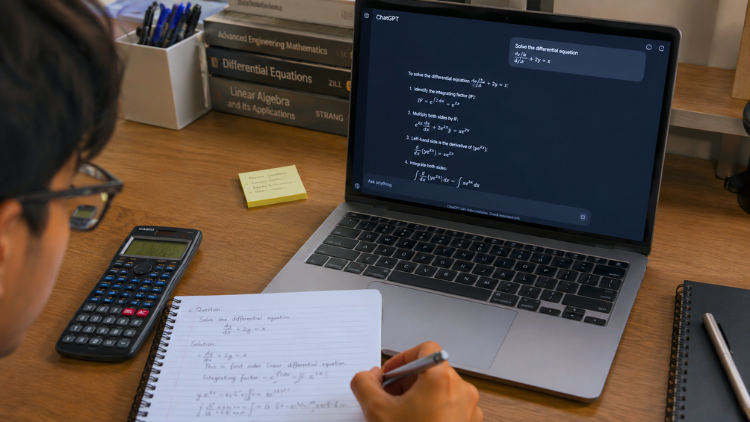
And that, to me, is the more interesting finding.
The AI didn’t make the students worse while they were using it. It made them better.
The problem appeared when they had to do the work themselves. That’s a subtle distinction, but it matters enormously.
If you use AI to help you understand something, challenge your assumptions, explore different approaches, or get through repetitive work, you’re still actively involved in the process. But if the tool becomes the place where the reasoning happens, you can get very good at producing answers without necessarily getting better at producing the thinking behind them.
That is where cognitive offloading becomes complicated.
The issue isn’t whether you use AI. The issue is how you use AI or what you stop doing yourself because AI is here.
The distinction is far more important for professionals at work.
An employee who uses AI to research faster, explore ten ideas instead of two, automate repetitive tasks, or build an AI-powered workflow can create enormous leverage. Another employee can use the same tools to generate the strategy, make the recommendation, produce the work, and then spend thirty seconds approving whatever appears on the screen.
Both are “using AI.” But they are not building the same capability.
And as AI moves deeper into knowledge work, that distinction is going to matter more—not just for how productive we are, but for which parts of our work remain uniquely valuable.
This brings us to the uncomfortable question: when should we let AI tools do the entire thinking process, and when should we insist on doing some of it ourselves?
When AI Stops Assisting and Starts Doing the Thinking

There is a point in almost every AI workflow where you suddenly realize that the machine has done most of the work and you are sitting there doing what might generously be called quality control.
AI researches the topic, structures the argument, writes the first draft, analyzes the data, creates the presentation, and sometimes even tells you what you should do next. Your job becomes reading the output and making sure the AI hasn’t confidently recommended something completely ridiculous.
And honestly, that is incredibly useful.
This is exactly why AI is changing knowledge work so quickly. A marketer can explore ten campaign ideas instead of two. A developer can automate repetitive coding. A customer-service team can handle routine queries without involving a human every time. An analyst can process hundreds of documents without spending three weeks reading them. An AI agent can now move through an entire workflow while you are doing something else.
The problem isn’t that AI is doing more work.
The problem appears when it starts performing part of the job that was making you better at the work.
This distinction is already showing up in the labour market. A Stanford study using payroll data found that employment among 22–25-year-olds in the most AI-exposed occupations had declined by 16% relative to less-exposed occupations, while more experienced workers in those same occupations remained comparatively stable.5 The researchers found that the decline was concentrated in occupations where AI was more likely to automate work rather than augment it.
Anthropic’s 2026 labour-market analysis paints a slightly more cautious picture. It found no systematic increase in unemployment among workers in highly AI-exposed occupations, but it did find suggestive evidence that hiring of younger workers has slowed in those professions. Computer programmers, customer service representatives, and financial analysts are among the occupations with high observed AI exposure.
No need to sweat yet. This isn’t the part where I tell you that AI is going to replace everyone by next Thursday.
The more interesting thing is happening underneath the headline.
AI doesn’t necessarily need to replace an entire job to change its value. It can first remove the smaller pieces—the research, the first draft, the repetitive analysis, the basic code, the routine customer interaction. Once enough of those pieces disappear, the number of people required to perform the whole job can change too.
And this brings us back to cognitive offloading.
There is nothing wrong with using AI to remove work that doesn’t need your brain. If I ask an agent to clean a spreadsheet, summarize fifty customer interviews, or turn a pile of meeting notes into something usable, I’m not losing much. I’m getting rid of mechanical effort so I can spend my attention somewhere more valuable.
The problem starts when I hand over the part of my job that was developing my judgment.
If AI researches the market, identifies the patterns, decides which insight matters, writes the strategy, and recommends what we should do next, what exactly am I getting better at?
Approving AI output?
That’s not the same as becoming better at strategy.
And this is why I think we need to start distinguishing between AI-powered workflows and AI-led workflows.
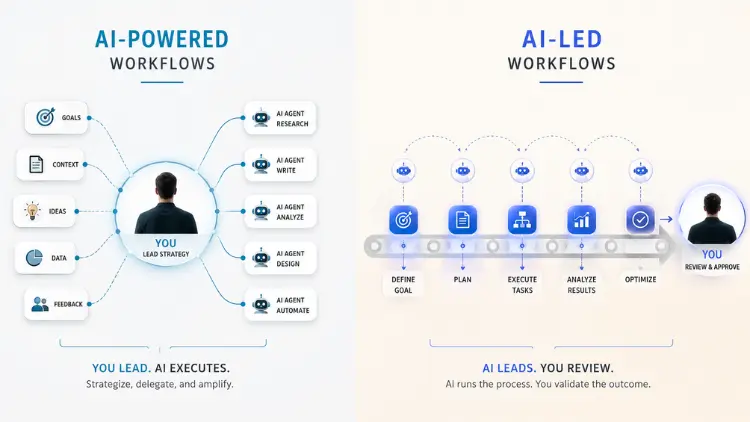
An AI-powered workflow uses AI aggressively, but the human remains responsible for the problem, the context, the important decisions, and the outcome. AI can research, analyze, draft, automate, monitor, test, and execute. It becomes leverage.
An AI-led workflow flips that relationship. The AI decides what needs to happen, produces the answer, chooses the direction, and the human mostly reviews what has already been decided.
It looks efficient.
It can also make you replaceable very quickly.
Because if your primary contribution becomes approving whatever the AI has already produced, you are no longer using AI to multiply your capability. You are becoming the final checkpoint in an automated workflow.
The people who gain the most from AI won’t necessarily be the ones who delegate the most.
They’ll be the ones who know what to delegate, what to keep, and where their own judgment creates disproportionate value.
And that is the question we need to answer next: if AI can handle almost every mechanical part of thinking, what parts of thinking should we still insist on doing ourselves?



GET COMPLETE FRAMEWORK
TOOLKIT — ONE PRICE
All nine frameworks, bundled — the complete system for thinking, deciding, and building better, for one flat price instead of buying each one separately.
One bundle. Nine frameworks. Lifetime access.
Thinking With AI: How the Best Professionals Build Leverage
Imagine two employees with the same AI tools begin work on a Monday morning.
One uses AI agents to research faster, clean data, generate possibilities, automate repetitive work, and test ideas. The machine does the heavy lifting, but the human still decides what problem is worth solving, which direction makes sense, and what ultimately gets shipped.
The other lets AI do the research, decide what matters, write the strategy, produce the output, and recommend the next move. His contribution is mostly giving the final nod to an otherwise decided flow.
Both are “using AI.” But only one of them is building AI leverage.
The best people I know using AI to create leverage and get ahead have this in common: automate the hell out of execution; be extremely selective about automating judgment.
Let AI summarize fifty interviews. Let an agent clean your data. Let it generate ten campaign ideas before you’ve finished your coffee. But don’t let it decide which customer problem matters, what your strategy should be, or whether its beautifully written recommendation actually makes sense.
That’s thinking with AI.
The people who gain the most from AI won’t necessarily be the ones who use the most tools. They’ll be the ones who redesign their workflows so AI handles everything that shouldn’t require manual hours, while they spend more time on judgment, context, creativity, and decisions.
The irony is that AI may actually make deep thinking more valuable, not less.
When everyone can generate a strategy in thirty seconds, knowing whether that strategy is bullshit becomes highly valuable. When everyone can produce a decent presentation in thirty seconds, the ability to know what the presentation should actually say becomes more valuable.
However, most people are already going at it backwards. Trying to learn about all the AI tools out there and thinking it will make them stand apart. There are already millions of creators and coaches trying to sell you workshops about how to use more tools effectively.
Yes, learning about different tools is imperative, but the systems and the processes are far more important.
AI makes production cheaper. It makes judgment far more valuable. And this is the leverage opportunity.
Build Your AI Advantage
Stop using AI like everyone else.
A private 2-hour session to find exactly where AI creates real leverage in your work — and leave with a plan you can act on immediately.
- A personalised AI stack mapped to your workflow
- Automation opportunities in your business
- A tailored 90-day action plan for you
- Direct access to pressure-test your thinking
Final Words
For most of human history, thinking wasn’t optional. If you wanted to solve a problem, make a decision, write something worth reading, or figure out what to do next – no agent was waiting in your pocket to do the difficult part for you. You had to sit with the uncertainty, make sense of the mess, get things wrong, and eventually figure it out.
Today, we can skip most of that. And that is an incredible advantage.
However, it can also become an incredible weakness if we forget that the difficult part was doing something for us.
AI will keep getting better. The responses will become faster, more accurate, more contextual, and eventually so good that asking whether the machine can do something for us will become almost irrelevant.
The more important question will be whether we still know when it shouldn’t.
The most expensive thing AI can steal may not be our jobs, our time, or even our skills. It may be the habit of thinking for ourselves.
And unlike a job, you may not realize you’ve lost it until you need it again.
Footnotes
- Don’t even get me started on Claude Cowork. ↩
- A broader review of generative AI research shows that these tools can lower cognitive effort while also affecting performance, making the net effect highly task-dependent—source: Author(s). (2025). Effects of generative artificial intelligence on cognitive effort and task performance. [Journal/archived article]. PMC: PMC12255134. ↩
- Nataliya Kosmyna, Eugene Hauptmann, Ye Tong Yuan, Jessica Situ, Xian-Hao Liao, Ashly Vivian Beresnitzky, Iris Braunstein, and Pattie Maes, “Your Brain on ChatGPT: Accumulation of Cognitive Debt when Using an AI Assistant for Essay Writing Task,” arXiv preprint arXiv:2506.08872 (2025). Read the paper ↩
- Hamsa Bastani, Osbert Bastani, Alp Sungu, Haosen Ge, Özge Kabakcı, and Rei Mariman, “Generative AI without guardrails can harm learning: Evidence from high school mathematics,” Proceedings of the National Academy of Sciences 122, no. 26 (2025): e2422633122. Read the paper ↩
- Erik Brynjolfsson, Bharat Chandar, and Ruyu Chen, “Canaries in the Coal Mine? Six Facts about the Recent Employment Effects of Artificial Intelligence,” Stanford Digital Economy Lab, November 13, 2025. ↩