

You have probably heard the phrase “step outside your comfort zone” hundreds of times before reading this article.
So had I.
In fact, for years, I treated it like one of those motivational clichés people throw around on social media between pictures of sunsets and overpriced coffee. It sounded good. It looked good on posters.
But I never really understood what it meant in practice.
The more I observe people, the more convinced I become that most individuals don’t fail because they lack talent, intelligence, or ambition.
More often than not, they fail because they become too comfortable where they are.
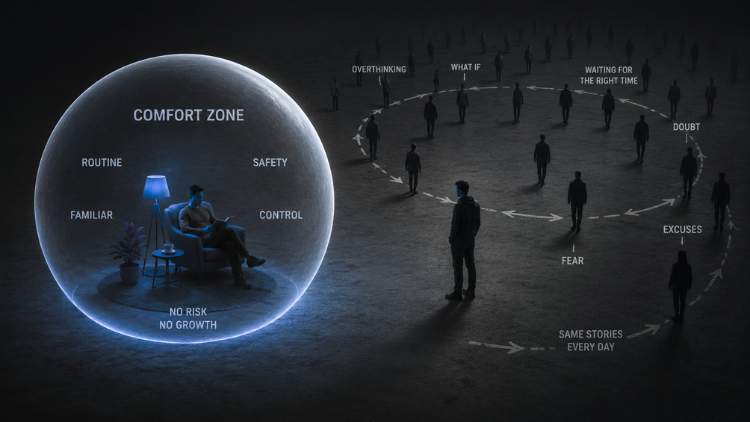
The dangerous thing about comfort is that it never arrives looking dangerous.1 It doesn’t announce itself as fear, procrastination, or weakness. It usually arrives disguised as logic.
You tell yourself you’ll start next month when things settle down. You’ll launch the business after doing a little more research. You’ll apply for that opportunity when you’re more confident. You’ll have the difficult conversation when the timing feels right.
Individually, these decisions seem reasonable. The problem begins when temporary delays slowly become permanent habits. Days turn into months, months turn into years, and before you realize it, you’ve spent more time preparing for life than actually living it.
You’ve probably seen this happen around you. Maybe you’ve even caught yourself doing it. You stay in a job you’ve outgrown because the salary feels safe. You keep postponing an idea you’ve been excited about for years because you’re waiting for the “right time.” You avoid taking a risk because uncertainty feels uncomfortable.
Nobody consciously chooses mediocrity. You simply choose comfort often enough that comfort becomes your default setting. And that’s where the real danger begins.
By the time you recognize what’s happening, you haven’t failed dramatically. You’ve simply spent years protecting your current life instead of building the life you actually wanted.
The Modern World Rewards Comfort
One of the biggest reasons comfort has become such a powerful force in our lives is that modern life is designed to reward it. Think about how dramatically life has changed over the last twenty years. Food arrives at your doorstep within minutes. Entertainment is available twenty-four hours a day. Almost anything you want can be delivered, streamed, automated, or outsourced with a few taps on a screen.
Convenience itself isn’t the problem. In many ways, it’s one of the greatest achievements of modern civilization. The problem begins when convenience slowly becomes your default response to discomfort. A few years ago, boredom was a normal part of life. You waited in lines. You sat quietly with your thoughts. You stared out of a bus window during a long journey. Today, the moment boredom appears, your hand automatically reaches for your phone.
The moment discomfort appears, you look for a distraction. The moment uncertainty appears, you look for reassurance.
Without realizing it, you’ve trained yourself to escape uncomfortable emotions before they have a chance to teach you anything.
Now AI is accelerating this trend even further.
For the first time in history, we’re entering a world where not only physical effort but even mental effort can be outsourced. AI can write emails, create presentations, summarize research, generate code, build websites, and increasingly perform tasks that once required hours of focused work.
The opportunities are extraordinary. But every opportunity comes with a hidden risk.
If you use AI correctly, it can increase your capability. If you use it carelessly, it can increase your dependency.
That distinction matters.
Because the purpose of technology should be to help you achieve more, not to help you avoid effort altogether.
I’ve noticed an interesting pattern whenever people talk about productivity and AI. Very few people ask, “How can I achieve ten times more with these tools?” More often, the question sounds like, “How can I get the same result with less work?”
At first glance, those questions seem identical.
They’re not.
One mindset is driven by ambition. The other is driven by comfort. One uses technology as leverage. The other uses technology as an escape.
If you’re trapped inside your comfort zone, you’ll rarely use AI to expand your potential. More often, you’ll use it to reduce the amount of effort required to achieve the same result.
Danger lies when the goal quietly shifts from growth to convenience because confidence is still built when you do things you’re uncertain about. Resilience is still built when things don’t go according to plan. Self-belief is still built when you survive experiences you once thought you couldn’t handle.
No AI agent can do that work for you. No automation can build character on your behalf. No productivity tool can replace the growth that comes from confronting discomfort directly.
The irony is that you now live in a world with more opportunities than any generation before you. But you also live in a world with more ways to avoid discomfort than any generation before you.
The question is no longer whether opportunity exists. The question is whether you’re willing to leave the comfort of convenience long enough to take advantage of it.
A Weekly Newsletter for Clarity & Updates.
Psychology, AI leverage, and the systems behind smart decisions — delivered directly to your inbox once a week.
No spam. Unsubscribe any time.
The Law of Assumed Continuance
There is a pattern in human behavior that explains far more than procrastination, comfort zones, or missed opportunities.
I call it the Law of Assumed Continuance.
The idea is simple. As human beings, we naturally behave as if life will continue exactly as it is.
We assume there will always be another opportunity to start the business. Another chance to repair the relationship. Another year to improve your health. Another month to pursue the goal you’ve been postponing.
Even when we understand life is unpredictable, we continue acting as if tomorrow has somehow been guaranteed. I’ve caught myself doing this more times than I can count.
Whenever a goal felt difficult or uncomfortable, my mind would immediately begin negotiating with the future. Instead of taking action, I would start making plans. Detailed plans. Sensible plans. Productive-looking plans.
The problem was that many of those plans weren’t creating progress. They were simply creating an illusion of permission.
Permission to delay. Permission to postpone. Permission to stay comfortable for a little longer.
The strange thing is that the human mind is incredibly good at creating logical explanations for inaction. You tell yourself that you need more preparation. More knowledge. More confidence. More clarity. And sometimes those things are genuinely necessary.
But often, they’re simply sophisticated forms of avoidance. The future thus becomes a psychological hiding place.
You convince yourself that the person you will become six months from now will be more disciplined, more courageous, more motivated, and somehow better equipped to do the thing you’re unwilling to do today.
But if you’ve been alive long enough, you’ve probably realized something important – the future version of you thinks exactly like the current version of you.
The same fears follow you. The same doubts follow you. The same excuses follow you. The only thing that changes is the date on the calendar. That’s why so many people spend years waiting for the perfect moment and never find it.
The perfect moment doesn’t arrive. You create it through action.
One of the more unapologetic reasons comfort becomes so dangerous is that it works hand in hand with this illusion. The more comfortable you become, the easier it is to assume there will always be more time.
You tell yourself you’ll take the risk later. You’ll have the conversation later. You’ll chase the dream later. You’ll become the person you want to become later. And later quietly becomes never.
I am not writing this to create urgency through fear. I simply wish to mention that some of the biggest regrets in life don’t come from failure. They come from realizing that you had more time yesterday than you do today, and you spent it assuming there would always be more tomorrow.
The moment you stop assuming life will continue exactly as it is, something changes. You stop negotiating endlessly with the future. You stop waiting for ideal conditions. You stop treating time as an unlimited resource.
And for the first time, you begin acting on what matters now instead of what might matter someday.
Why Fear Keeps Us Stuck
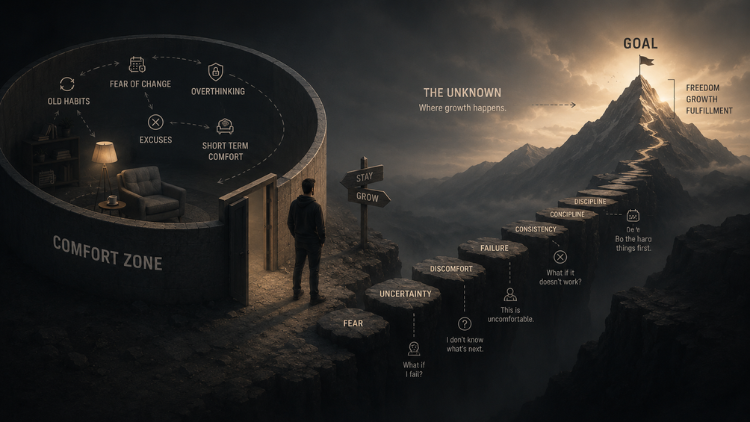
If comfort is the prison, fear is usually the guard standing at the gate.
Most of us like to believe that we’re rational people. We tell ourselves that our decisions are based on logic, analysis, and careful thinking. But when you look closely at many of the decisions that shape our lives, fear is often sitting quietly in the background, influencing far more than we’d like to admit.
Fear of failure. Rejection. Embarrassment. Uncertainty. Fear of what other people might think.
The interesting thing is that fear rarely stops us directly. It simply convinces us not to start. It tells us to wait. To prepare a little more. To think about it longer. To revisit the idea when conditions improve. And because these suggestions sound reasonable, we listen.
I know this because I’ve done it myself.
For a large part of my life, I was an introvert. Not the social-media version of introversion that people casually mention in conversations, but the kind where talking to strangers felt uncomfortable, expressing opinions felt risky, and stepping into unfamiliar social situations required a significant amount of mental energy.
At the time, it felt like that was simply who I was.
I wasn’t avoiding discomfort. I was just being myself. At least that’s what I believed. Looking back, I realize that many of the limitations I accepted as personality traits were actually fear in disguise.
The fear of being judged. The fear of saying something really stupid. The fear of looking awkward amongst a bunch of strangers or even close friends. The fear of not fitting in.
And because I accepted those fears as part of my identity, I never challenged them. That’s another thing fear does remarkably well. It will convince us that our mental comfort zone is our personality.
We say and accept things like:
- “I’m just not good at networking.”
- “I’m not the kind of person who prefers to take risks.”
- “I’m not naturally confident.”
- “Public speaking isn’t for me.”
The problem isn’t that these statements are always false. The problem is that they often become permanent conclusions based on temporary limitations.
Once I started deliberately putting myself into situations that made me uncomfortable, something interesting happened.
I didn’t become fearless. I simply collected evidence. Evidence that I could handle conversations I once avoided. Evidence that I could survive situations that once intimidated me. That many of the fears controlling my decisions were far bigger in my imagination than they were in reality.
And that’s when I realized something important.
Most people wait to feel confident before they take action. But confidence is usually the reward for action, not the requirement.
Read that AGAIN !!!!
The same is true for courage, resilience, and growth. You don’t develop these qualities by thinking about them. You develop them by repeatedly doing things that challenge the version of yourself you’ve become comfortable being.
Fear never completely disappears. You’ll always find new situations that make you slightly uncomfortable. The difference is that you stop treating fear as a stop sign. You start treating it as information.

Expanding Your Comfort Zone Without Overwhelming Yourself
One of my favorite quotes comes from The Mentalist, which goes something like this –
“Nothing is impossible. Every task can be accomplished as long as it’s broken down into small and manageable pieces.”
The older I get, the more valuable that statement feels. Most people don’t struggle because their goals are impossible. They struggle because they only focus on two points of the journey: where they are today and where they want to be eventually.
You imagine the successful business, the book you’ve always wanted to write, the promotion, the financial freedom, the healthier body, or the life you’ve been dreaming about for years. The destination is exciting. The gap between where you are and where you want to be is terrifying.
That’s where most people get stuck. Not because they lack ambition or desire. But because they lack a map.
Over the years, I’ve found it useful to think about growth through a framework I call Reverse Engineering Goals. Instead of asking, “What should I do today?” start by asking, “What exactly am I trying to achieve?”
Get specific.
Visualize the outcome clearly enough that you can almost see it. Then work backwards.
Let’s say you want to start a business in the AI era. A few years ago, building a business often felt overwhelming because there were too many unknowns. Today, you can sit down with an AI agent and ask it to break the entire journey into milestones.
What skills do I need? Which product should I build? How do I validate demand? How do I market it? What systems do I need for operations, sales, and customer support? Within minutes, you can have a roadmap that would have taken weeks to create manually. The challenge is no longer figuring out what to do. The challenge is doing it.
Once the roadmap exists, break it into major milestones. Break those milestones into projects. Break those projects into actions. Eventually, what looked like an impossible goal becomes a series of manageable steps. This is when something interesting happens psychologically. The mountain disappears. All you see is the next step.
Think about two people being asked to run five kilometers. One person is told to run because it’s good for them. The other is told that someone they love needs their help at the finish line.
The distance is identical. The discomfort is identical. But the meaning is completely different. And meaning changes everything.
The same principle applies to your goals. When you can clearly see where you’re going and understand why each step matters, discomfort stops feeling like punishment. It starts feeling like progress.
The comfort zone feels powerful when you’re staring at the entire mountain. It becomes much weaker when you’re focused on the next few meters of the climb.
Build Your AI Advantage
Stop using AI like everyone else.
A private 2-hour session to find exactly where AI creates real leverage in your work — and leave with a plan you can act on immediately.
- A personalised AI stack mapped to your workflow
- Automation opportunities in your business
- A tailored 90-day action plan for you
- Direct access to pressure-test your thinking
Final Thoughts
The more I think about comfort, the more I realize that it isn’t something you can completely remove from your life. Nor should you.
The goal was never to live in a constant state of discomfort. The goal was never to make reckless decisions, take unnecessary risks, or chase uncertainty for the sake of it. The real challenge is much simpler.
It’s learning to recognize the difference between comfort that helps you recover and comfort that quietly holds you back.
I’ve noticed that some of the biggest turning points in my own life didn’t come from dramatic decisions. They came from moments when I finally stopped postponing something I already knew needed to be done.
More often than not, comfort zones are so difficult to recognize because they don’t feel like prisons. They feel like home. And perhaps that’s the real challenge. Not escaping your comfort zone, but recognizing when you’ve stayed there longer than you should have.
Because the opportunities available to you today are greater than ever before. You have access to knowledge, tools, technology, and leverage that previous generations could only dream about.
Hence, the question is no longer whether you can build something meaningful. The question is whether you’re willing to be uncomfortable long enough to become the person capable of building it.
Because your future is rarely changed by one giant leap.
It’s changed by the small decisions you make when comfort asks you to stay exactly where you are.
And growth asks you to take one more step.
Footnotes
- Comfort feels very sweet in the beginning, like a dessert. ↩