

A few years ago, I came across a friend, let’s call her Isha.
At first glance, there was nothing extraordinary about Isha. She wasn’t a famous influencer. She wasn’t a prodigy. She wasn’t the founder of a sexy startup or the protagonist of some inspirational movie.
She was simply a young girl trying to live an ordinary life. Then suddenly life stopped being ordinary.
Within a relatively short span of time, she lost her father. The financial security her family had relied on for years vanished almost overnight. Problems that most adults struggle to navigate unexpectedly became part of her daily routine.
On most days, it’s enough to break anyone. But not Isha. What fascinated me wasn’t what happened to her. It was what happened next.
Instead of becoming bitter, she became stronger. Instead of feeling defeated, she became more determined. While her circumstances changed dramatically, something within her remained remarkably stable, focused, and resilient.
That, in all honesty, was extraordinary. Not because her story was unique or special. But because it wasn’t.
I’ve seen the opposite happen just as often. More often than not, I’ve seen people break or succumb in the face of adversity.
I’ve seen people with supportive families, successful careers, financial stability, and opportunities most of the world would envy become completely overwhelmed by setbacks that seemed insignificant from the outside.
The contrast was impossible to ignore. Why do some people seem to grow through adversity, while others are defined by it?
Why does one person treat hardship as a chapter, while another allows it to become the entire story?
For years, I thought the answer had something to do with intelligence, talent, education, or opportunity. Eventually, I realized I was wrong. The difference wasn’t what these people possessed externally.
It was what they had built internally. And I call it emotional wealth.
The more I observe people, the more convinced I become that emotional wealth may be one of the most important forms of wealth a person can possess.
We’ll come back to Isha’s story later.
For now, let’s talk about why, for most of us, our definition of wealth is kind of broken and distorted, as we completely ignore the substance of wealth that matters most when life becomes difficult.
A Weekly Newsletter for Clarity & Updates.
Psychology, AI leverage, and the systems behind smart decisions — delivered directly to your inbox once a week.
No spam. Unsubscribe any time.
We Measure Success Using the Wrong Currency
If an alien landed on Earth and spent a week scrolling through Instagram, LinkedIn, and YouTube, it would probably arrive at a very simple conclusion:
Humans are obsessed with two things: 1) collecting evidence of success and 2) showcasing evidence of success.
Promotions. Luxury vacations. New cars. Startup funding announcements. Job titles. Number of Followers. Net worth.
And to be fair, none of these things are inherently bad. The strange part is what we don’t measure.
Nobody asks how emotionally resilient you are. Or how well you handle uncertainty. Nobody asks whether you can recover from failure without questioning your entire identity.
In fact, imagine updating your LinkedIn profile like this:
Emotional Stability: Excellent
Ability to handle rejection: Advanced
“Recovered from three major life setbacks without a psychological meltdown.”
It sounds ridiculous.
Yet those qualities will probably have a greater impact on the quality of our lives than many of the things we proudly display on our résumés.
That’s because we’ve become exceptionally good at measuring visible forms of wealth and remarkably bad at recognizing invisible ones.
Money is a form of wealth. Knowledge is a form of wealth. Relationships can be a form of wealth. But there is another type of wealth that rarely gets discussed. A type of wealth that determines how you respond when life becomes difficult.
How quickly you recover from setbacks. How much uncertainty can you tolerate? How much adversity can you absorb without losing yourself in the process?
I call it emotional wealth.
And unlike financial wealth, it cannot be measured by what you own. It can only be measured by who you’ve become.

What Is Emotional Wealth?
Here’s the strange thing about emotional wealth.
You’ve probably been building it your entire life without ever realizing it.
Nobody teaches you to think about it. There are no school subjects dedicated to it, no monthly statements tracking it, and no app that sends you a notification saying, “Congratulations, your resilience increased 5% this month.”
Yet some of the most important moments in your life have quietly contributed to it.
One of the reasons emotional wealth is so difficult to recognize is that it doesn’t look like wealth.
When you think about wealth, your mind naturally imagines things you can see and measure. Money sitting in a bank account. Investments compounding over time. A successful business. A house. A promotion. An increment. These are all visible forms of wealth, and because they are visible, they are easy to value.
Emotional wealth works differently.
There is no dashboard tracking it. Nobody congratulates you for becoming more patient, more adaptable, or better at handling uncertainty. Yet if you think about it carefully, some of the most valuable things you possess today were built through experiences that never appeared on any résumé, report card, or balance sheet.
Think about your own life for a moment.
The challenges you’ve faced. The plans that didn’t work out. The disappointments you never saw coming. The failures that forced you to start over. At the time, most of those experiences probably felt like a sharp knife twisted in your gut.
You wanted them to end. You wanted things to go back to normal. You certainly weren’t thinking, “This is building something valuable inside me.” Nobody does.
But looking back, many of those experiences left you with something.
Perhaps they taught you patience when things weren’t moving as quickly as you wanted. Maybe they taught you perspective by showing you that most problems eventually pass. And eventually, they taught you how to navigate through uncertainty, recover from setbacks, or trust yourself during difficult periods of life.
Whatever form those lessons took, they became part of you. That’s emotional wealth.
Emotional Wealth in Action
It’s not happiness. It’s not constant positivity. And it’s certainly not pretending everything is fine when it isn’t.
If you’ve ever met someone who remains surprisingly calm during difficulties, you’ve already seen emotional wealth in action.
Chances are that this person also gets stressed out. They also experience disappointment. They still have bad days. The difference is that they won’t allow those moments to completely consume them.
Somewhere along the way, they learned how to absorb setbacks without losing themselves in the process. They learned how to adapt when circumstances changed, recover when things didn’t go according to plan, and keep moving forward even when life became uncomfortable.
That’s what emotional wealth really looks like in the real world.
Not a feeling. A capacity.








GET COMPLETE FRAMEWORK
TOOLKIT — ONE PRICE
All nine frameworks, bundled — the complete system for thinking, deciding, and building better, for one flat price instead of buying each one separately.
One bundle. Nine frameworks. Lifetime access.
The Day Emotional Wealth Becomes Visible
The interesting thing is that emotional wealth usually remains invisible until life decides to test it.
When life is going well, emotional wealth rarely attracts your attention. If your career is progressing, your relationships are stable, your health is good, and your plans are unfolding more or less as expected, it’s easy to assume that you’re doing great. And perhaps you are.
You discover how emotionally wealthy you are when something important falls apart. When uncertainty enters your life uninvited. When a relationship ends, a business struggles, an opportunity disappears, or gets lost.
These are the moments when emotional wealth stops being an abstract concept and becomes something very real.
That’s when the real test begins.
When life is even slightly uncertain, knowledge alone isn’t enough. Money isn’t always enough. Talent isn’t always enough. What often determines your response is the emotional infrastructure you’ve built beneath the surface.
Your ability to adapt matters. Your ability to recover matters. Your ability to stay grounded matters.
And that’s why I’ve come to believe that emotional wealth deserves far more attention than it receives. Financial wealth can make life more comfortable, but emotional wealth determines how you respond when life becomes uncomfortable. In the long run, that difference matters far more than most people realize.
Being emotionally wealthy and resilient will not make adversity disappear. However, it changes how you react when adversity unfolds.

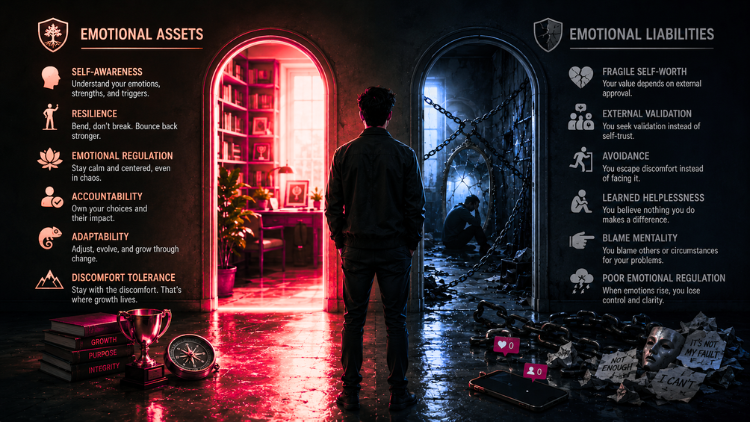
Emotional Assets vs Emotional Liabilities
One of the most useful ways to think about emotional wealth is to stop looking at it through the lens of psychology and start looking at it through the lens of accounts & finance.
Most of us understand the concept of assets and liabilities. Assets make us stronger. Liabilities make us vulnerable.
What fascinates me is that the same principle applies emotionally, yet very few of us ever think about ourselves this way.
Take a moment and imagine that, alongside your bank account, career history, and LinkedIn profile, you also had access to an emotional balance sheet. A document that tracked your emotional assets and emotional liabilities with complete honesty.
What would it reveal?
Would it show resilience or avoidance? Self-trust or dependence on validation? Adaptability or rigidity? The ability to engage in difficult conversations, or a habit of running away from them?
Most of us have a pretty good idea of how much money we have and how much we spend. Whether we’re moving forward or backwards. Emotionally, however, many of us are operating almost entirely in the dark.
Think about the last time you failed at something or were criticized by someone.
Were you able to sit with the discomfort, extract something useful, and move on?
Or did the criticism stay with you for days? Did it slowly transform from merely being a feedback thought into self-loathing and self-doubt? Did that single comment begin influencing the way you viewed yourself?
The event in itself rarely matters. What matters is your response.
Because what you really experience in such moments isn’t the setback. You’re seeing your emotional balance sheet in action.
This is where emotional assets and emotional liabilities begin to reveal themselves.
Emotional assets are the qualities that increase your ability to navigate uncertainty, adversity, and change. Things like resilience, self-awareness, emotional regulation, accountability, adaptability, and the ability to tolerate discomfort without immediately trying to escape it.
Emotional liabilities work in the opposite direction. A fragile sense of self-worth. An unhealthy dependence on external validation. Avoidance. Learned helplessness. The tendency to blame circumstances for everything that goes wrong. The inability to regulate emotions when reality refuses to cooperate with your plans.
The challenge is that emotional liabilities rarely appear as liabilities. They often arrive disguised as habits, preferences, or personality traits.
“I’m just an overthinker.”
“I care too much about what people think.”
“This is just how I am.”
I’ve noticed that some of the most expensive emotional liabilities are the ones we stop questioning. Once we begin treating them as part of our identity, we stop trying to change them.
And that’s when we begin to bear the real cost of our emotional liabilities.
Because life eventually tests every emotional balance sheet. Not once, but repeatedly.
A difficult conversation. A betrayal. Financial or any other kind of loss. Rejection. Failures. An unexpected crisis. They are all part of the package we call life.
And ironically, when life tests us, it does so as a remarkably honest auditor.
It doesn’t care how successful you appear, how intelligent you are, or how carefully you’ve curated your social image. It simply reveals what was already there.
And that’s why two people can experience the same event and walk away with completely different outcomes.
Not because the event was different.
But because the emotional balance sheets they carried into that experience were considerably different.
The Five Deposits That Build Emotional Wealth
If emotional wealth is real, and if emotional assets can be accumulated over time, then how exactly does that happen?
After all, experience alone clearly isn’t enough. Life can smack almost anyone in the face. Not everyone stands back.
Adversity tests almost every person eventually. Not everyone emerges stronger.
This is something I’ve thought about often while reflecting on people like Isha. What separated her response from countless others wasn’t simply the difficulty of the experience. It was what she did with the experience.
The more I’ve observed people, the more I’ve come to believe that emotional wealth is built through a series of repeated emotional deposits.
Every difficult experience allows you to make one of those deposits, but only if you process the experience in a useful way.
The first deposit is awareness.
Most people navigate life on autopilot. They experience frustration, disappointment, rejection, or failure without ever stopping to examine how such experiences affect them internally.
Awareness is the ability to notice our reactions before they become patterns. Without awareness, experience remains experience. With awareness, experience becomes information.
The second deposit is reflection.
An experience only becomes valuable when you extract something from it. Failure in itself isn’t the lesson. The lesson is hidden deep inside the failure. Reflection is what allows you to separate the two.
The third deposit is ownership.
This may be one of the most important deposits of all. The moment you stop asking, “Why is this happening to me?” and start asking, “What can I do with this?” you reclaim a degree of agency over your life. Ownership transforms you from a passive participant into an active one.
The fourth deposit is meaning.
Two people can endure the same hardship yet experience it differently depending on the meaning they attach to it. If an experience is viewed purely as suffering, it often becomes an emotional liability. If it is viewed as a challenge, a lesson, or an opportunity for growth, it has a far greater chance of becoming an emotional asset.
The fifth deposit is integration.
This is the step most people overlook. Insight is useful. However, application is transformative. Emotional wealth grows when lessons become behaviors, when realizations become habits, and when understanding begins influencing the way you live.
Build Your AI Advantage
Stop using AI like everyone else.
A private 2-hour session to find exactly where AI creates real leverage in your work — and leave with a plan you can act on immediately.
- A personalised AI stack mapped to your workflow
- Automation opportunities in your business
- A tailored 90-day action plan for you
- Direct access to pressure-test your thinking
Final Thoughts
It’s quite intriguing that none of these five deposits requires perfect settings. In fact, they usually happen during the most imperfect ones.
Difficult conversations. Rejections. Failures. Unanticipated losses.
Life provides the raw material. It’s up to you to decide on which side of the ledger you’ll make the deposit – the assets or the liabilities?
And perhaps that’s why some people seem to grow through adversity, stronger and better, while others spend a lifetime giving excuses – only if.
The experience is only the beginning.
What happens next is where emotional wealth is built.




Super informative, thank you, I appreciate you taking the time to research and for sharing what you found and your thoughts. I found the intensity curve to be really interesting and absolutely loved your line “Life is essentially a struggle for intensity.” I mean… (insert expletive language) how true and yet, so simple that one statement is. Well done, my friend, again thank you!
It’s my pleasure to be able to do this. And thanks, to take the time for your kind words and appreciation. It really helps me.